
Dehumidifier for a Finished Basement in Winter
Updated
Short answer
Part of Walls and Moisture.
The numbers to hold
EPA's mold guide says to keep indoor humidity below 60 percent, ideally between 30 and 50 percent, and that relative humidity can be measured with a moisture or humidity meter, a small, inexpensive ($10 to $50) instrument sold at hardware stores (EPA, A Brief Guide to Mold, Moisture and Your Home). The CDC says to keep humidity levels “as low as you can, no higher than 50 percent, all day long,” with an air conditioner or dehumidifier to help (CDC, About Mold and Your Health). EPA's house tour has a basement entry: if a room such as a basement is too humid, use a dehumidifier to help prevent mold growth, and clean it regularly following the maker's instructions (EPA, Text version of the Mold House Tour).
Why the basement is the hard room
Building Science Corporation explains the physics. The structural parts of below-grade walls are cold, especially when insulated on the interior, and allowing interior air to touch cold surfaces causes condensation and wetting (Building Science Corporation, Basement Insulation for All Climates (Information Sheet 511)). A finished basement adds a second problem: walls and furniture hold moisture where air does not move.
Winter in Rockford
EPA's advice for high humidity includes opening windows when it is not humid outside. In a northern Illinois winter that is rarely an option, so the equipment has to do the work. The same cold concrete that drew condensation in summer is colder in winter. We found no source that gives a Rockford indoor winter humidity figure, so the practical approach is to measure. Put a meter on a wall in the finished room, check it for a few weeks and write down the readings.
What to do with the reading
- Under 50 percent. Nothing to do. Keep the meter in place.
- 50 to 60 percent. Run a dehumidifier and look for a moisture source: a laundry vent, an unvented dryer, a bathroom without a fan. EPA says clothes dryers must be vented outdoors.
- Above 60 percent. Stop and look for water before you finish. See the waterproofing guide.
Where the unit goes
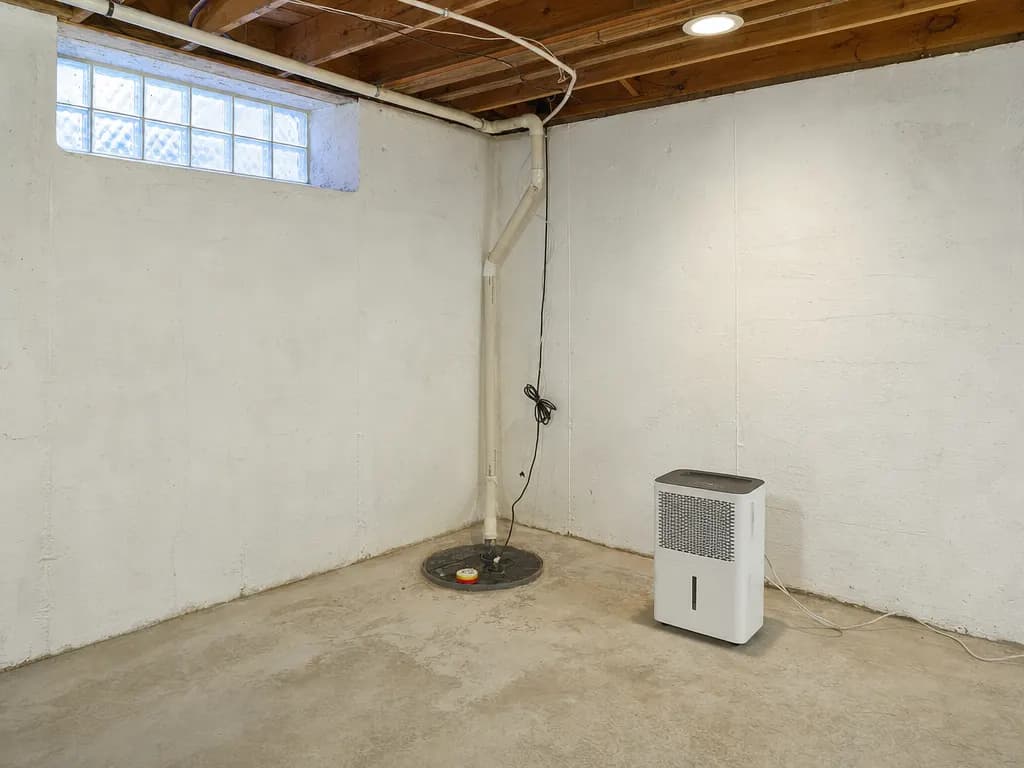
A portable dehumidifier needs a drain. Many have a bucket to empty; many also have a drain hose connection that can run to a floor drain or the sump pit. If your finish will close in the mechanical area, plan a spot for the dehumidifier and its drain line. A whole-basement unit ducted into the HVAC is a mechanical permit question. Ask your office.
The design side
Inside the walls, the Department of Energy and Building Science Corporation say to use materials that tolerate moisture and to avoid interior polyethylene. See the vapor barrier guideand the mold prevention guide.
Where basement humidity comes from
EPA's mold guidance lists the usual sources: clothes dryers that are not vented to the outside, cooking and washing dishes, showers, wet foundations and leaks. A finished basement often contains several of them at once, such as a laundry area, a bathroom and a wet bar. Dry any wet area within 24 to 48 hours, and see condensation on windows, walls or pipes as a prompt to act quickly to dry the surface and reduce the source (EPA, A Brief Guide to Mold, Moisture and Your Home).
A simple log
- Put the meter on an interior wall, away from the sump and the dryer, at chest height.
- Write down the reading each morning for two weeks, and again after laundry and showers.
- Mark the days with rain or snowmelt next to the readings.
- If the readings stay above 50 percent, run the dehumidifier and keep logging.
- If they climb above 60 percent with the unit running, look for a water source rather than buying a bigger unit.
Where to go next
This guide sits under Basement walls and moisture. Every price on this site, with its source and date, is on the basement finishing cost page. If this topic is on your list, these guides cover the neighbouring questions: Preventing Mold in a Finished Basement, Waterproofing a Rockford Basement Before Finishing, and Do You Need a Vapor Barrier in a Basement Wall?.
Quick answers
What humidity should a finished basement stay at?
EPA recommends below 60 percent relative humidity, ideally 30 to 50 percent. The CDC says no higher than 50 percent.
How do I measure basement humidity?
Use a moisture or humidity meter. EPA says these cost $10 to $50 and are sold at hardware stores. Track readings for a few weeks, including after rain and laundry days.
Do I need a dehumidifier if the basement is finished?
That depends on the readings. EPA says to use a dehumidifier if a room such as a basement is too humid, and to find and fix the moisture source.
Can a dehumidifier fix a wet basement?
A dehumidifier lowers air humidity. It does not stop liquid water from entering. If walls or the floor take on water, fix that first, as covered in the waterproofing guide.
Planning a basement finish?
Tell us the size of the basement and what you want down there. We reply with a price range first.