
What Makes a Basement Bedroom Legal in Illinois?
Updated
Short answer
Part of Basement Bedroom.
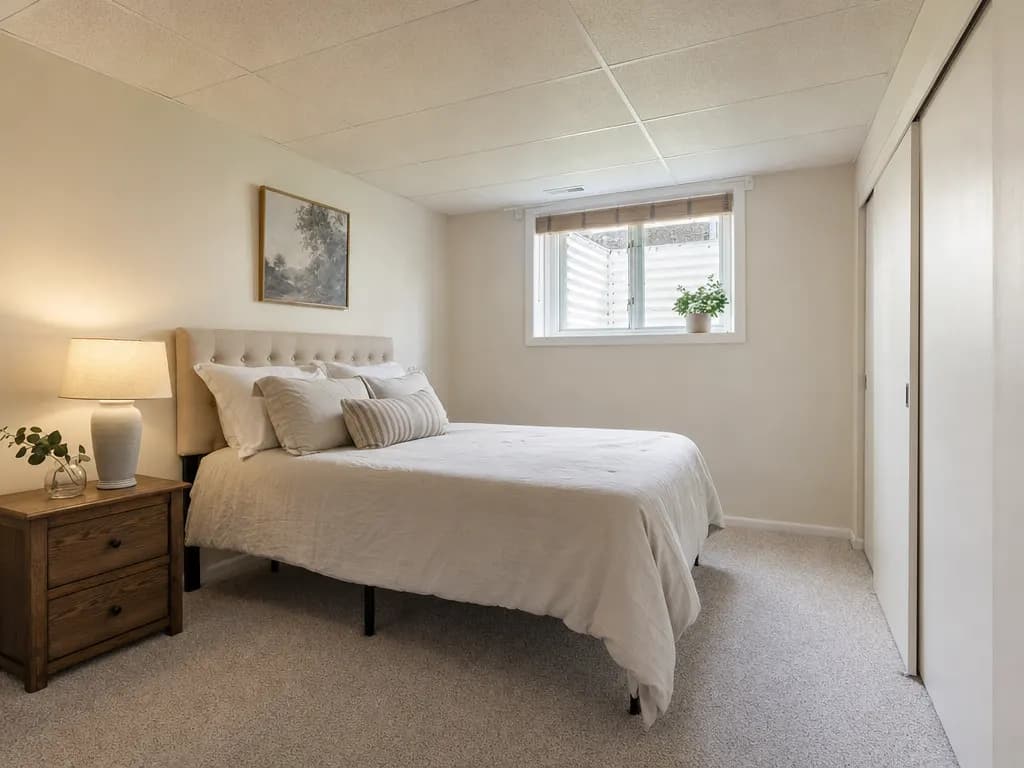
Illinois does not define a bedroom in a single law. Four separate rules combine to make a room a legal sleeping room, and a basement fails on one of them more often than any other room in the house. Here is each one, with its source.
1. An escape opening in the room itself
The model code says “Basements, habitable attics and every sleeping room shall have not less than one operable emergency escape and rescue opening.” The opening has to be in the sleeping room; an egress window in the basement family room does not cover a bedroom behind a door. Sizes, sill height and window wells are in the egress guide and the window well guide.
2. A ceiling at least 7 feet high
Habitable space needs a 7 foot ceiling. Beams, girders and ducts may project below that height in a basement, to within 6 feet 4 inches of the floor under the 2021 text. See the ceiling height guide and the low ceilings guide if yours is short.
3. A smoke detector within 15 feet
“Every dwelling unit or hotel shall be equipped with at least one approved smoke detector in an operating condition within 15 feet of every room used for sleeping purposes.”
4. A carbon monoxide alarm within 15 feet
The State Fire Marshal puts the rule this way: homeowners, landlords and building owners are required to install carbon monoxide detectors within 15 feet of rooms used for sleeping, as of January 1, 2007 (the law applies where a home has fossil-fuel appliances or an attached garage). Details are in the alarm guide.
What no one rule says
None of the Illinois sources we read lists a closet as a requirement, so a basement bedroom without one is not automatically illegal under these rules. A local amendment or a real estate listing practice can differ. Another point that matters at resale: Fannie Mae's appraisal rules treat any level with a portion below grade as below grade, regardless of its finish, so a basement bedroom is not counted in the above-grade room count even when it meets code (Selling Guide B4-1.3-05). That does not make the room worth less to a buyer who will use it, but it explains why an appraisal and a listing may not call it a bedroom.
Permit and cost
A bedroom adds framing, electrical and usually an egress cut, and in Rockford those are permitted work (see the permit guide). HomeGuide puts a finished basement bedroom at $3,000 to $12,000 (HomeGuide, national, updated February 6, 2026), which excludes the egress window if one has to be cut. The cost page has the egress ranges.
A quick pre-build checklist
- Does the room have an exterior wall where a window and well can go? If not, a door to the outside is the other route.
- Is the clear ceiling height 7 feet or more after the subfloor and ceiling are installed?
- Is there room to place a smoke alarm within 15 feet of the bedroom door and a CO alarm within 15 feet?
- Does the permit drawing label the room as a bedroom so that the inspector checks it as one?
- Does the heating system reach the room? We found no Illinois source with a basement heating rule, so ask the permit office.
Rental units are different
If the bedroom is part of a unit you rent, add disclosure duties. The Radon Awareness Act requires landlords to disclose radon to tenants below the third story, and the smoke detector statute puts responsibilities on owners for rental dwelling units. See the Radon Awareness Act guide. Whether a basement apartment is allowed at all is a zoning question for the municipality, and we did not research local rules on secondary units.
Where to go next
This guide sits under Basement bedrooms. Every price on this site, with its source and date, is on the basement finishing cost page. If this topic is on your list, these guides cover the neighbouring questions: Basement Egress Window Requirements in Illinois, Smoke and CO Alarms in a Finished Basement, Minimum Ceiling Height for a Finished Basement, and Egress Window Well Size and Ladder Rules.
Sources: Minnesota DLI, emergency escape fact sheet (reproduces 2021 IRC R310.2); 2021 IRC R305.1 ceiling height (ICC); 2021 IRC R310.1 emergency escape and rescue openings (ICC); Illinois Smoke Detector Act, 425 ILCS 60/3; Illinois State Fire Marshal, carbon monoxide detectors; HomeGuide; Fannie Mae Selling Guide B4-1.3-05, above- and below-grade areas
Quick answers
Can a basement bedroom be legal without a window?
The model code requires an operable emergency escape and rescue opening in every sleeping room. A narrow sprinkler exception exists, but a window or door that meets the size rules is the usual route.
How close must a smoke detector be to a basement bedroom?
Illinois law requires at least one approved smoke detector within 15 feet of every room used for sleeping purposes. Carbon monoxide alarms are required within 15 feet of sleeping rooms as well.
What is the minimum ceiling height for a basement bedroom?
Habitable space needs a ceiling of at least 7 feet under the 2021 model code. Beams and ducts can project below it, to within 6 feet 4 inches of the floor.
How much does a basement bedroom cost?
HomeGuide puts a finished basement bedroom at $3,000 to $12,000, a national range updated February 6, 2026. See the cost page for the full table.
Planning a basement finish?
Tell us the size of the basement and what you want down there. We reply with a price range first.