
Moisture-Resistant Drywall for a Basement
Updated
Short answer
Part of Framing and Drywall.
What the sources say
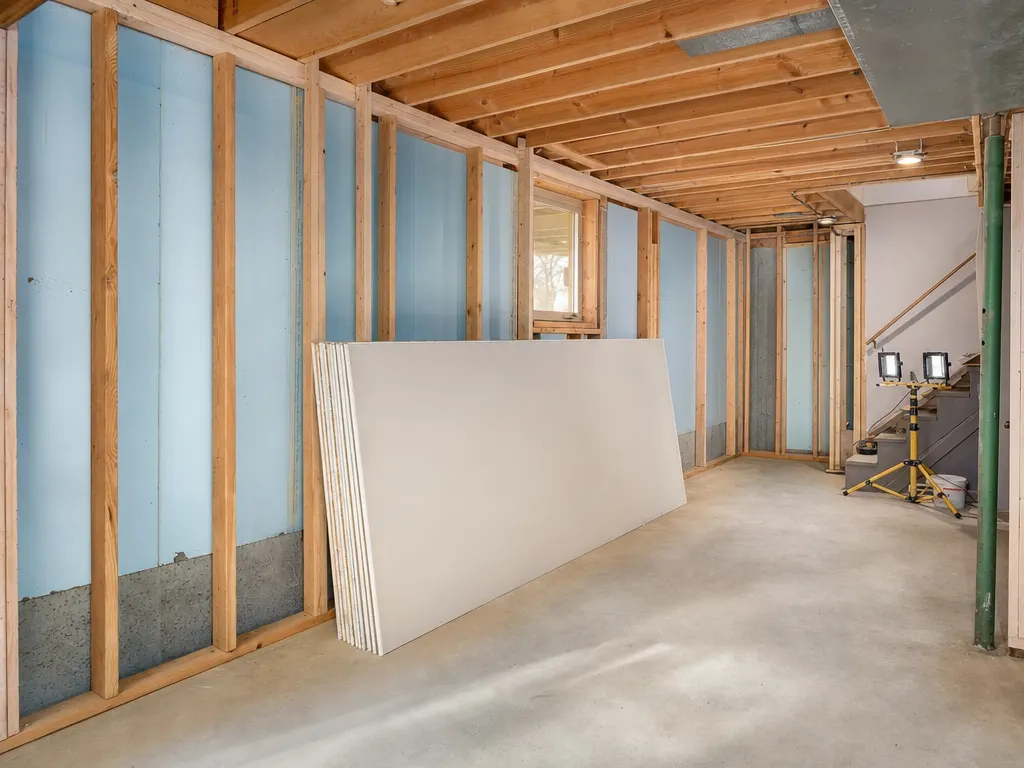
The Building America report on renovating basements is the clearest primary source. On the layer that covers foam, it says extruded polystyrene is flammable and must be protected by a 15 minute thermal barrier such as 0.5 inch of gypsum board, and that “in a below grade space such as a basement, a gypsum board without paper facings is recommended” (Building Science Corporation, Renovating Your Basement for Moisture Control (Building America report 0309)). The DOE basement wall job aid agrees on the thickness: when using foam, gypsum board must be at least 1/2 inch to meet building code requirements as a thermal barrier (U.S. DOE, Job aid: air seal and insulate basement walls (June 2024)).
The two basics
- Paperless facing. Mold needs an organic food source and moisture. Paper is organic. A board with a glass-mat or other non-paper face removes that food source from the wall surface.
- A gap at the floor. The Department of Energy says to leave at least a half-inch gap between the drywall and the floor. The gap keeps the bottom edge out of water that reaches the slab. The baseboard covers it.
What a label does and does not tell you
We found no primary standard in our sources that defines the retail terms moisture-resistant, mold-resistant or water-resistant board, and the products differ by brand. Read the manufacturer's data sheet and ask for the mold-resistance rating and the stated limits of use. Typical limits say not for direct water exposure or standing water. A moisture-resistant sheet over a wall that takes on liquid water will still fail; the framing and insulation behind it are still wet. See the mold prevention guide.
Where to use it
- On the walls, over the foam and frame assembly. See the insulation guide.
- Around a basement bathroom or wet bar, where splash and steam are routine.
- Near the sump pit and water heater.
- Ceilings are less exposed. A drop ceiling can avoid wet drywall entirely; see the ceiling guide.
Cost
National guides price drywall by the square foot and in total. They do not separate moisture-resistant board, so ask the drywaller for the upcharge as a line item on the bid.
| Item | Range | Market | Source and date |
|---|---|---|---|
| Drywall | $1.50 to $3 per sq ft | national | Angi, updated July 9, 2026 |
| Drywall | $1.50 to $3.50 per sq ft | national | HomeGuide, updated February 6, 2026 |
| Drywall | $800 to $3,000 | national | This Old House, page titled 2026 Pricing, update date not shown |
More lines are on the cost page.
Permit and fire rules
Gypsum board over foam is a fire/ignition barrier requirement, so the inspector will look at it. Rockford's local amendment also treats replacing wall coverings as exempt only when half or less of a room's covering is removed and no framing is exposed to the point where hardwired smoke alarms become required (City of Rockford, Building Permits). A full basement finish is not that case.
Hanging and finishing details
- Hold the board up half an inch from the slab, and cover the gap with a baseboard that does not touch the floor tightly.
- Use half-inch or thicker board over foam, and fasten into the framing or furring, not the foam alone.
- Tape and finish with products the board maker allows for that board.
- Prime and paint with latex, not epoxy, oil or alkyd, which DOE lists as Class I vapor retarders on interior basement walls.
- Leave the plumbing and electrical access points open until the inspector has signed off.
Questions for the drywaller
Ask which board they price, who makes it and what the data sheet says about moisture and mold resistance. Ask whether the bid separates board cost from labor and finishing. Ask how they treat the bottom edge and the corners near the sump or a bathroom. Compare answers across bidders. A bid that gives the product name makes the comparison easy; a bid that says only “drywall” leaves a gap you will not see until the walls are up.
Where to go next
This guide sits under Framing and drywall. Every price on this site, with its source and date, is on the basement finishing cost page. If this topic is on your list, these guides cover the neighbouring questions: Preventing Mold in a Finished Basement, Basement Wall Panel Options: What to Check, Framing Basement Walls Against Concrete, and Drywall Ceiling or Drop Ceiling in a Basement?.
Sources: City of Rockford, Building Permits; HomeGuide; Angi; This Old House; Building Science Corporation, Renovating Your Basement for Moisture Control (Building America report 0309); U.S. DOE, Job aid: air seal and insulate basement walls (June 2024); U.S. DOE, Basement insulation systems (Building America Top Innovation)
Quick answers
What drywall should I use in a basement?
Building Science Corporation recommends gypsum board without paper facings below grade, at least half an inch thick over foam as a thermal barrier. Check the manufacturer's data sheet for limits.
Is green board waterproof?
We found no primary source defining the moisture-resistant label. A moisture-resistant board is not waterproof, and a wall that takes on liquid water needs the water fixed rather than a different board.
Should drywall touch the basement floor?
The Department of Energy advises a gap of at least half an inch between the drywall and the floor, which keeps the bottom edge out of any water on the slab.
How much does basement drywall cost?
HomeGuide puts drywall at $1.50 to $3.50 per sq ft, a national range updated February 6, 2026. See the cost page for other sources.
Planning a basement finish?
Tell us the size of the basement and what you want down there. We reply with a price range first.